
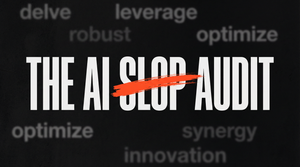
Merriam-Webster just named "Slop" the 2025 Word of the Year.
If you're in marketing, that should terrify you. Or, if you're like me, it should be the loudest signal you've heard in a decade.
The "Sea of Sameness" isn't coming. It's already here. It’s the millions of "Ultimate Guides" published every hour that say absolutely nothing. It’s the "robust solutions" and the "digital landscapes" that clog up our feeds.
It’s slop.
And in 2025, if your content sounds like a bot, your brand is already dead.
I’m taking you into the trenches with me to show you how to audit your strategy, kill the faceless filler, and build a human-first engine that search engines actually respect.
Why "Slop" is the Word of the Year (and the Enemy of Your Brand)
When a dictionary names a slang term for "low-quality synthetic waste" as its word of the year, the market is screaming.
The novelty of AI is gone. People are no longer impressed that a machine can write a 2,000-word blog post. They’re annoyed by it. They’re skeptical of it.
They’re starving for a human face.
Slop is what happens when you treat AI as a "Publish Button" instead of a "Draft Engine." It’s the result of lazy prompting and zero editing. It’s "empty calories" for the internet.
And the cost is higher than you think. Every time you publish a piece of faceless slop, you’re training your audience to ignore you. You're teaching them that your brand has no soul.
In 2025, attention is the only currency. You can’t buy attention with a bot. You have to earn it with insight.
The Google 2025 "Filler" Penalty: Why Your 3,000-Word Guide is Failing
For years, the SEO game was simple: write more words than the other guy.
Google’s 2025 updates (specifically the June and December Core Updates) have officially killed that game. They've introduced what I call the "Filler Penalty."
Google’s Quality Rater Guidelines now specifically target "filler content", those long, generic AI introductions that bury the actual answer under layers of "In today’s fast-paced digital world..."
Google now frequently ranks an 800-word expert piece over a 3,000-word AI-generated "ultimate guide" that lacks original insight.
Why? Because the 800-word piece has Verified Authority.
Google is looking for "citation patterns", whether real humans are talking about your specific expertise. It’s looking for "First-Party Data", numbers you pulled from your own business, not a rehash of a Statista chart from 2019.
If your strategy is to out-produce the bots, you’ve already lost. You can’t out-volume a machine. But a machine can’t out-human you.
The "Read Aloud" Test: 5 Linguistic Markers That Scream "I'm a Bot"
I have a simple rule in my agency: If you wouldn't say it to a friend over a beer, delete it.
AI has a specific "scent." It writes in perfect grammar with zero personality. It uses words that nobody actually uses in real conversation.
If you want to audit your content for slop, look for these 5 linguistic markers. If you see them, you’re leaking trust.
1. The "Delve" Default
If I see the word "delve" or "dive into," I immediately stop reading. Real people say "let's look at" or "here's the deal." AI loves the academic pretense of "delving."
2. The "Robust" Reality
Vague, corporate-speak like "robust," "comprehensive," or "seamless." These words mean nothing. They are placeholders for actual descriptions. Instead of "robust solution," tell me exactly how it saved a client 14 hours a week.
3. The "Landscape" Lingo
"Navigating the complex digital landscape." "In the realm of marketing." This is filler. It adds no value. It’s the hallmark of an LLM trying to sound smart while saying nothing.
4. The Triple Pattern
AI loves things in threes. Three benefits. Three examples. Three subpoints. It’s too clean. Humans are messier. We have two points, or four, or a rambling tangent that actually matters.
5. Perfect Parallelism
Every bullet point is the same length. Every sentence starts with a verb. It’s too rhythmic. It lacks the "Human Delta", the staccato, the fragments, and the "And" or "But" that starts a sentence for emphasis.
Try this: Read your last blog post out loud. If you stumble, or if you feel embarrassed saying the words, it’s slop. Kill it.
The Human Delta: Finding the 10% AI Can't Replicate
I’m not anti-AI. I use it every day. But I use it for the 90% that doesn't matter.
The Human Delta is the 10% that AI will never be able to write. This is where the battle for authority is won.
The Human Delta consists of four things:
- Personal Experience with Specifics: AI can tell you "how to run a meeting." It can’t tell you about the time you lost a $50k client because you forgot to record the Zoom call. That failure is your superpower.
- Proprietary Data: AI remixes the web. It doesn't have access to your CRM, your client results, or your internal experiments. Use your own numbers. Even small numbers are better than generic ones.
- Opinion with Reasoning: AI is a fence-sitter. It says "Some experts believe X, while others say Y." Real experts have takes. They say "X is bullshit, and here is exactly why."
- Current Context: AI is trained on the past. It doesn't know what happened on Twitter three hours ago. It doesn't know the specific vibe of your industry right now.
If your content doesn't have at least one of these in every section, it’s a commodity. And commodities are being replaced by free AI tools.
From "Publish Button" to "Draft Engine": A New Content Workflow
Most people use AI like a "Publish Button." They prompt, they copy, they paste.
That is how you build a faceless brand that nobody cares about.
In my "Human-First" approach, I use AI as a "Draft Engine." Here is the exact process we use in the trenches:
Step 1: Think by Hand (or Voice)
We start with a voice memo or a messy pen-and-paper outline (best achieved when written by hand). We define the "Human Delta" first. What is the one thing we know that a bot doesn't?
Step 2: The Junior Intern Prompt
We feed that raw insight into the AI. We treat it like a junior intern. We say: "Here is my core idea. Give me 5 different ways to structure this. Find 3 statistics that back up my point about X."
Step 3: The Brutal Feedback Agent
We use a second AI agent specifically tasked with being a "Slop Auditor." We tell it: "Find every corporate word in this draft. Flag every sentence that sounds like a textbook. Where am I being generic?"
Step 4: The Human Polish
This is where the real work happens. We rewrite the intro. we add the fragments. We inject the "I" and the "You." We apply the "Read Aloud" test.
This process takes more work than hitting "Generate." But the result is content that actually builds a business.
The Algorithmic-Proof Checklist: Auditing Your 2025 Strategy
Before you hit publish on anything this year, run it through this audit. If you can't check every box, you're publishing slop.
- Does it answer the query in the first 200 words? (No "digital landscape" intros).
- Is there at least one personal story or "in the trenches" failure?
- Are there specific numbers or proprietary data?
- Does it pass the "Read Aloud" test? (Would you say this to a friend?)
- Is the "Human Delta" visible? (What is the 10% a bot couldn't write?)
- Does it take a clear stand? (No fence-sitting "some experts say" talk).
- Are the headers scannable but high-insight?
The era of "volume-based" content is over. The era of "trust-based" content is just beginning.
If you want to survive the AI flood, stop trying to be more efficient. Start being more human.
No fluff. No dancing. Just the real strategy.
Frequently Asked Questions
What is AI slop?
AI slop is low-quality, mass-produced synthetic content that adds no value, lacks human insight, and is often generated by users who hit 'publish' without editing. It's the digital equivalent of empty calories, it looks like content but provides no nutritional value to the reader.
Does AI content hurt SEO in 2025?
Google doesn't penalize AI content just for being AI. However, it does penalize 'filler content' and content that lacks original insight. If your AI-generated content is generic, repetitive, and provides no unique value (aka slop), it will be de-ranked under Google's 2025 Quality Standards.
How to identify AI slop in marketing?
The fastest way is the 'Read Aloud' test. If a sentence sounds like something no human would ever say to a friend, it's slop. Look for linguistic markers like 'delve,' 'robust,' 'landscape,' and perfect-yet-boring sentence structures.
What is the 'Human Delta' in content?
The Human Delta is the 10% of content that AI can't replicate: personal experience, proprietary data, unique opinions, and 'in the trenches' failures. It's the difference between a generic how-to guide and a practitioner's field report.
Are we using AI as a 'Draft Engine' or a 'Publish Button'?
A 'Publish Button' approach is where you prompt and post. That's a one-way ticket to slop. A 'Draft Engine' approach uses AI to organize your thoughts, research facts, or suggest outlines, while a human writes the final voice and adds the insight.
How to prove content is human-written in 2025?
You don't prove it with badges; you prove it with proof. Use specific numbers, mention real client results, admit to mistakes you've made, and link to your own source material. Proof of work is the only anti-slop signal that lasts.