
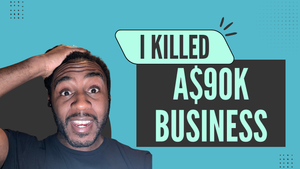
I walked away from $90,000 a year.
Not because the business failed. Not because clients left.
I let it go.
In 2020 I started an SEO freelance business in Vancouver. Over five years I grew it to $90K/year, while staying employed full-time. Local businesses, e-commerce clients, Google rankings, the whole thing. Life was genuinely good.
Then AI rewrote the rules.
When Google started rolling out AI Overview, that big box that pushes organic results below the fold, I saw the writing on the wall. My local clients were never going to do what it takes to win in the new landscape: Reddit presence, YouTube content, high-friction, always-on content creation. They didn't have the budget. They didn't have the time.
And I wasn't going to keep taking their money knowing the ROI was gone.
So I ended it. All of it. Told every client to go run paid ads. Referred them out. Said goodbye.
It cost me $90,000 a year to do the right thing.
It's also the decision I'm most proud of.
Now I'm rebuilding from scratch, in public, pivoting into video-first content with a new business called Expert Insight Sessions. I'm documenting every step here, live, as it happens. The wins, the mistakes, the weird ideas I'm testing at 11pm.
This is Stream 001. This is Issue 001.
Let's go.
① The Employeepreneur Advantage
Everyone online tells you the same story: build your side business until it replaces your income, then quit and go all-in. I'm glad I didn't listen.
Being employed while running a business isn't a stepping stone, it's a strategic position. The bank loves you. You get enterprise-scale learning and boots-on-the-ground experimentation at the same time. You can take real risks without desperation driving every decision.
I call it the Employeepreneur model. Not a consolation prize. A deliberate choice. And I think it's the right model for a lot of people who have the drive to build but don't want to bet the mortgage on it.
More on this in a future post, I'm planning to go deep on the concept. But it's a core thread running through everything I'm doing.
② The Wu-Tang Content Strategy
RZA's genius wasn't just the music, it was the distribution (RZA was the leader and creator of The Wu-Tang Clan).
Nine artists. Nine different record labels. Each label pushing the Wu-Tang logo with their own marketing budget, their own tours, their own reach. One brand, everywhere, all year, without RZA paying for all of it himself.
That's exactly the model I'm running for Expert Insight Sessions. One client interview per month. One piece of source material. Repurposed into blog posts, newsletters, LinkedIn clips, Instagram Reels, YouTube Shorts. The content does the touring. The client only shows up once.
Cream gets the money. Wu-Tang is for the kids. And one interview should last a full month.
③ Skip the Sales Call. Send a 5-Minute Video.
Nobody actually wants to book a 60-minute discovery call. They click the button, they dread it, then half of them ghost you anyway.
I'm testing something different.
When someone raises their hand on an ad, I send them a personalized 5-minute video, pain point, solution, process, pricing, next step, everything they need to decide, in one short watch. No scheduling anxiety. No pitch deck. No hour-long dance.
If they're in, they click forward. If they have questions, we jump on a 15-minute call to close it out. That's it.
It's a crazy idea, maybe. But I'd rather send 50 five-minute videos than sit through 50 glazed-over discovery calls. We'll see what the data says.
This is Stream 001 of Building in Public, a weekly Sunday 8am PST livestream where I'm building Expert Insight Sessions live, in real time.
No polish. No highlight reel. Just the actual work.
If you want to follow the full journey, watch the first stream here: → [Watch Stream 001]
See you next Sunday at 8am PST.
— Chris
P.S. .— If you know someone who's been sitting on business idea but can't figure out how to make it work alongside their day job, forward this to them. The Employeepreneur conversation needs to happen more.